
The Nikkei Markit India Manufacturing Purchasing Managers' Index increased to 50.7 in February

Analysts polled by Reuters had expected output to grow 0.7 per cent annually.
.jpg)
The marginal improvement in the index of industrial production was mainly on account of higher power generation and mining sector output, while manufacturing declined.

As many as seven of eight core industries saw a contraction in output in September.

India's industrial output unexpectedly rose 1.2 per cent in May from a year earlier, led by a pick up in manufacturing, government data showed on Tuesday.

The main factor boosting production was a sustained rise in new work inflows.

A reading below 50 means contraction in the sector.

The Ficci survey, which covered 276 units, also revealed that those expecting a fall in their production decreased to 16 per cent in the second quarter from 26 per cent in the first quarter.

From the Sensex basket, Kotak Mahindra Bank, HCL Technologies, ICICI Bank, Infosys, Tata Consultancy Services, Wipro, Tech Mahindra and Larsen & Toubro were the major laggards. Mahindra & Mahindra, Nestle, Tata Motors and IndusInd Bank were among the gainers.

Among the Sensex firms, JSW Steel, Tata Steel, Tech Mahindra, Infosys, Wipro, Tata Consultancy Services, Nestle, HCL Technologies, HDFC Bank and Maruti were the major laggards. IndusInd Bank, ITC, Bharti Airtel and State Bank of India were among the winners.

The services sector growth in India moderated in February amid softer expansions in business activity, sales and jobs, a monthly survey said on Tuesday. The seasonally adjusted HSBC India Services Business Activity Index registered 60.6 in February, down from 61.8 in January. In Purchasing Managers' Index (PMI) parlance, a print above 50 means expansion, while a score below 50 denotes contraction.
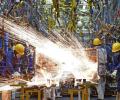
This is the ninth consecutive month that the manufacturing PMI remained above the 50-point-mark.

The Nikkei India Manufacturing Purchasing Managers' Index (PMI) stood at 47.9 in July, down from 50.9 in June, its lowest mark since February 2009, and highlighted the first deterioration in business conditions in 2017 so far.

PMI went up from 51.2 points in May to 53.1 in June. Owing to the June figure, PMI for manufacturing stood at 51.9 points in the first quarter of 2018-19 against 51.8 points in the fourth quarter of 2017-18.

India's services sector activities touched the highest mark since April 2011 amid ongoing improvements in demand conditions, even as cost pressures in the service economy remained stubbornly high, a monthly survey said on Tuesday. The seasonally adjusted S&P Global India Services PMI Business Activity Index rose from 58.9 in May to 59.2 in June -- its highest mark since April 2011. For the eleventh straight month, the services sector witnessed an expansion in output. In Purchasing Managers' Index (PMI) parlance, a print above 50 means expansion while a score below 50 denotes contraction.
India's services sector lost momentum in July as demand was curtailed by competitive pressures, elevated inflation and unfavourable weather, a monthly survey said on Wednesday. The seasonally adjusted S&P Global India Services PMI Business Activity Index fell from 59.2 in June to 55.5 in July, pointing to the slowest rate of growth in four months. For the 12th straight month, the services sector witnessed an expansion in output. In Purchasing Managers' Index (PMI) parlance, a print above 50 means expansion while a score below 50 denotes contraction.

The Reserve Bank of India, which mainly factors in retail inflation to decide its monetary policy, has been tasked by the government to ensure the rate of price rise remains around 4 per cent.
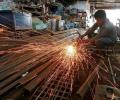

India's industrial production growth rose to a 14-month high of 10.3 per cent in August, mainly due to good show by the manufacturing, mining and power sectors, according to the official data released on Thursday. The factory output growth measured in terms of the Index of Industrial Production (IIP) had contracted by 0.7 per cent in August 2022. The previous high was recorded at 12.6 per cent growth in June 2022.

The internals of the food inflation are worrying, given a broad-based uptick across categories that tend to be sticky, such as proteins, and a narrower-than-expected reduction in inflation for vegetables.

India's industrial output grew a better-than-expected 6.4 per cent in August compared with a downwardly revised 4.1 per cent growth a month ago.

Capital goods output registered a steep decline of 16.5 per cent in June
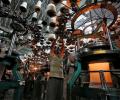
S&P Global Ratings on Tuesday raised India's growth projection for the current fiscal to -7.7 per cent from -9 per cent estimated earlier on rising demand and falling COVID infection rates. "Rising demand and falling infection rates have tempered our expectation of COVID's hit on the Indian economy. S&P Global Ratings has revised real GDP growth to negative 7.7 per cent for the year ending March 2021, from negative 9 per cent previously," S&P said in a statement. The US-based rating agency said its revision in growth forecast reflects a faster-than-expected recovery in the quarter through September. For the next fiscal, it projected India's growth to rebound to 10 per cent.
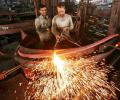
Economists surveyed by Reuters had forecast a 0.5 per cent growth in output

Smartphones have been a key success story of the government's production-linked incentive scheme, helping India become the second-largest mobile phone manufacturing country, after China.

PMI increased from 52.0 in August to 56.8 in September -- highest since January 2012.

India's manufacturing sector activity remained broadly flat in June as new orders declined for the first time in over four years and power cuts and fragile economic conditions weighed on the sector's performance, an HSBC survey said.

Meanwhile, IIP for June was revised upwards to a decline of 1.78 per cent from a provisional 2.2 per cent dip in production. It contracted by 2.8 per cent in May this year.

India's services sector activity expanded at the strongest pace in ten-and-a-half years in October, driven by a substantial upturn in business activity amid favourable demand conditions, a monthly survey said on Wednesday. Companies indicated that a notable pick-up in new business led to the fastest expansion in output in over a decade and as a result more jobs were created, even though business confidence remained subdued due to growing inflationary concerns. The seasonally adjusted India Services Business Activity Index rose from 55.2 in September to 58.4 in October, signalling the strongest rate of growth in ten-and-a-half years.
Industrial output in the April-June quarter too contracted by 0.1 per cent this fiscal, according to the official data released on Thursday.
The services sector growth in India rose to a three-month high in December supported by favourable economic conditions and positive demand trends, a monthly survey said on Friday. The seasonally adjusted HSBC India Services PMI Business Activity Index rose from 56.9 in November to 59 in December, highlighting a sharp increase in output that was the most pronounced since September. In Purchasing Managers' Index (PMI) parlance, a print above 50 means expansion while a score below 50 denotes contraction.

Firms hired additional hands to keep up with the production demand

The services sector growth in India fell to a one-year low in November on softer expansions in new work intakes and output, despite receding price pressures, a monthly survey said on Tuesday. The seasonally adjusted S&P Global India Services Business Activity Index fell from 58.4 in October to a one-year low of 56.9 in November. Despite witnessing a month-on-month decline, the rate of expansion was stronger than its long-run average.

The Nikkei Markit India Manufacturing Purchasing Managers' Index (PMI) -- an indicator of manufacturing activity -- declined from 52.5 in April to a three-month low of 51.6 in May.
Capital goods output rose by a robust 20 per cent in the month under review as against a contraction of 2.4 per cent earlier.

At a time when the government is nudging the private sector to ramp up its capital expenditure (capex), the Ministry of Statistics and Programme Implementation (MoSPI) is poised to kick-start the first-of-its-kind annual survey on the status of private sector capex from next month. "The inaugural edition of the annual exercise will start in October and will be completed by December. "The results will be made public by February next year," said Geeta Singh Rathore, director general, National Sample Survey Office (NSSO), at a data users' conference on Thursday.

The HSBC/Markit purchasing managers index for the manufacturing industry stood at 50.1 in July, slightly more than 50.3 in June, indicating a broad stagnation of manufacturing operating conditions in India.
Services sector activities improved further and touched a five-month high in April driven by a surge in incoming new work orders that boosted business activity and supported a renewed increase in employment, according to a survey. The seasonally adjusted S&P Global India Services PMI Business Activity Index jumped to 57.9 in April, from 53.6 in March, highlighting a sharp rate of expansion that was the fastest since last November amid mounting price pressures. For the ninth straight month, the services sector witnessed an expansion in output.
The collections from Goods and Services Tax (GST) grew by 15 per cent to over Rs 1.49 lakh crore in December 2022, indicating improved manufacturing output and consumption demand, besides better compliance. This is the 10th month in a row that the revenues have remained above the Rs 1.4 lakh crore mark. The collection in November was about Rs 1.46 lakh crore. "The gross GST revenue collected during December 2022 is Rs 1,49,507 crore, of which CGST is Rs 26,711 crore, SGST is Rs 33,357 crore, IGST is Rs 78,434 crore (including Rs 40,263 crore collected on import of goods) and cess is Rs 11,005 crore (including Rs 850 crore collected on import of goods)," the ministry said in a statement.
The seasonally adjusted India Services Business Activity Index rose from 45.4 in July to 56.7 in August, as the reopening of several establishments and increased consumer footfall boosted sales. The services sector witnessed the first expansion in output in four months and a rebound in business confidence.
